Categories
Blog

My Charlie Hebdo Week Rant

I usually don’t draw such wordy cartoons, but I thought this would get around better than if I wrote the same points in a column.

To explain this one, reading from left to right, the wart-hogs become progressively more disturbing. On the less disturbing left is The Los Angeles Times, which ran a blank, editorial cartoon shaped spot that wasn’t really blank, but contained a line of words, telling readers that this is what the world would look like if there were no editorial cartoons, with an attribution to the write who wrote those words. Ironically, The Los Angeles Times runs no cartoons three days a week or so – they could run that line three times a week with no blank spot. Cartoonists are at their best when times are tough and feelings run high. Editors are most cartoon averse when times are tough and feelings run high. (That said, the LA Times runs three or four of our cartoons a month – we usually love you, LA Times.)

The second wart-hog represents “Web pirates”, who are a problem for cartoonists most of the time, although now they have their heart in the right place with Charlie Hebdo tribute cartoons, and I can’t be too angry at them this week. I’m more angry with the big Web sites like The Daily Beast and The Huffington Post that are stealing cartoons and not paying the cartoonists right now. Even The New York Daily News is non-paying pirate now. Come on people – you should pay the cartoonists. Cartoons are cheap. You can see how important editorial cartoons are around the world now. Pay the cartoonists.

The third wart-hog is The Sun-Sentinel newspaper in Fort Lauderdale, Florida, which just laid-off their nationally syndicated cartoonist, Chan Lowe, at a time that couldn’t be more awkward. The Sun-Sentinel just dropped the most important part of their newspaper.

CharlieHebdoCoverMore on word-people who don’t get it – The New York Times and The Wall Street Journal, neither of which has an editorial cartoonist. My New York Times wart-hog says, “We can write about dead editorial cartoonists; we don’t need to hire any editorial cartoonists.” My faux quote is inspired by The New York Times‘ famous statement that they don’t need to show the Danish Muhammad cartoons because they can describe the cartoons with words – of-course, they can’t. And The New York Times has been making similar statements recently about not showing the Charlie Hebdo cover.

There are a couple of quotes from The New York Times that I have no attribution for, just cartoonist gossip, but they both ring true. The times is quoted saying, “We would never hire an editorial cartoonist because we would never give so much power to one man.” and the second quote: “We would never hire an editorial cartoonist because you can’t edit art like you can edit words.” At least they are honest, bone-headed word-people. Both The New York Times and The Wall Street Journal run cartoon illustrations, where they give an assignment to a illustrator, rather hiring a real editorial cartoonist who draws what he thinks, like a columnist writes what he thinks – no, not that.

President Obama is on the right. Instead of going to Paris with the other world leaders, Obama met with the N.B.A. Champion San Antonio Spurs. Looks like the White House is run by The New York Times.

Categories
Blog

The New Issue of Charlie Hebdo

CharlieHebdoCover
This is the cover of the Charlie Hebdo issue that was released after the attack. The full issue is in the pdf below. They printed 50 times more copies than usual, and still sold out right away.

The new issue of Charlie Hebdo just came out in France, greeted by long lines at newsstands; it reportedly sold out right away. Thanks to my alert buddy, Alan Gardner at thedailycartoonist.com, I’ve posted a downloadable pdf of the whole issue below.

I’m ashamed of my American journalist colleagues who refuse to show the Charlie Hebdo cover, among them The New York Times, The Wall Street Journal, The Associated Press and CNN.

The New York Times executive editor, Dean Baquet, explained his decision to characterize the cartoons in words rather than show them: “We have a standard that is long held and that serves us well: that there is a line between gratuitous insult and satire. Most of these [cartoons] are gratuitous insult.” Brooke Baldwin on CNN described CNN’s decision as partly based on considerations for their employees’ safety.

I would describe the New York Times’ many false articles about “weapons of mass destruction,” running up to the war with Iraq, as a “gratuitous insults” also.

CNN’s explanation is just cowardice.

Charlie Hebdo

Categories
Blog

American Response to the Charlie Hebdo Tragedy

American Response to the Charlie Hebdo Tragedy © Daryl Cagle,CagleCartoons.com,Charlie Hebdo, terrorism, killing, France, Paris, cartoonists, cartoon, Stéphane Charbonnier, Charb, Cabu, Wolinski, Tignous, media, television, TV, news, cartoonist, pundits, fox news, can, msnbc, Los Angeles Times, Wall Street Journal, New York Times, Florida Sun-Sentinel, Fort Lauderdale, Ft Lauderdale, Obama, president, community colleges, st louis spurs, basketball, sports

Categories
Cartoons

American Response to the Charlie Hebdo Tragedy

American Response to the Charlie Hebdo Tragedy © Daryl Cagle,CagleCartoons.com,Charlie Hebdo,terrorism,killing,France,Paris,cartoonists,cartoon,Stéphane Charbonnier,Charb,Cabu,Wolinski,Tignous,media,television,TV,news,cartoonist,pundits,fox news,can,msnbc,Los Angeles Times,Wall Street Journal,New York Times,Florida Sun-Sentinel,Fort Lauderdale,Ft Lauderdale,Obama,president,community colleges, st louis spurs,basketball,sports

Categories
Blog

Freedom of Expression

158580 600 Freedom of Expression cartoons

Categories
Blog Columns

Cartoonists and Red Lines


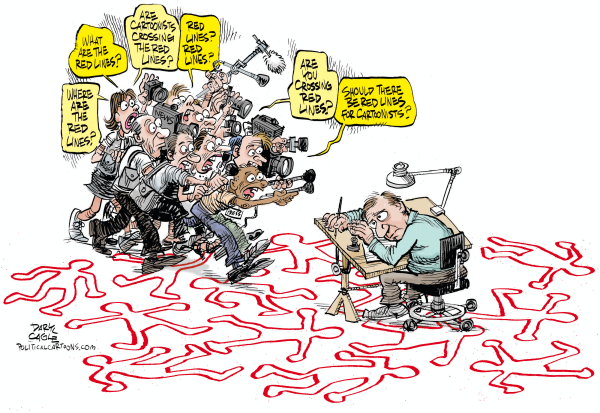
Like blaming a rape victim for her “provocative dress,” many press pundits blame the Charlie Hebdo cartoonists (and the Danish cartoonists before them) for crossing “red lines,” and inviting trouble. In the past few days the small community of American editorial cartoonists have been getting calls from their local media, asking for comments about self-censorship and what subjects we should be forbidden to draw in a free society.

Political cartoonists have no clear red lines, but we are certainly censored. Cartoonists are a macho bunch; we want to draw provocative cartoons, bashing the reader on the head with the most powerful images possible. Editors see cartoonists as bomb throwers, to be reigned in.

There are about fifteen-hundred daily, paid circulation newspapers in America, and less than fifty cartoonists have jobs working for those papers, the vast majority of the papers use “syndicated” cartoons, culling a cartoon or two each day from a large menu of available, national cartoon options. Newspaper editors have been growing more timid, wanting to avoid reprinting anything that might offend a declining readership; they usually avoid printing the most hard-hitting cartoons. The result is that American editorial cartoons are tame compared to cartoons around the world – and in France.

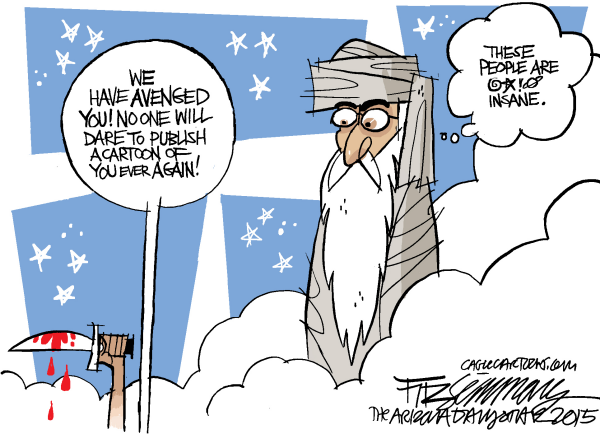
Yesterday, one of the cartoonists I syndicate, David Fitzsimmons of The Arizona Daily Star in Tucson, drew a cartoon depicting the Prophet Muhammad that we delivered to our 850 subscribing newspapers. Editorial cartoons depicting the Prophet Muhammad are not unusual. We were flooded with calls from editors questioning our wisdom in posting the cartoon, and asking if other editors were running it before deciding to run it themselves.
Cartoons are more powerful than words. Readers don’t cut columns out of the newspaper to hang on their fridges. Editors quickly learn that cartoons generate more angry e-mail than the same ideas expressed in words. Editors prefer cartoons that are like Jay Leno jokes, about a topic in the news, but expressing no real opinion. If we want our work to be reprinted, cartoonists have to consider drawings that timid editorial-gatekeepers will let pass. This is the censorship of the marketplace.

I know cartoonists who insist on drawing offensive cartoons with four letter words; they complain that the market is unfair for rejecting them. Tame cartoonists are sometimes derided by our macho colleagues for selling-out to syndication. My French cartoonist friends joke about American cartoonists being prudes. For example, the French draw bare breasts in their cartoons frequently; American cartoonists can’t do that if they want their cartoons to be reprinted in U.S. newspapers -a bare-breasted fact that amuses my French colleagues.

Our censorship of the marketplace in a free society is nothing like government censorship, a concept that is difficult for the much of the world to understand or appreciate. Around the world editorial cartooning is a dangerous profession, and censorship is real. Cartoonists in China self-censor, never drawing the Chinese president; cartoonists in Cuba have never drawn Fidel Castro. Our cartoonists in Singapore tell me they can draw whatever they want, as long as it isn’t about Singapore. Government censorship is so common around the world that calls for red lines seem reasonable to many.

Editorial cartoons are more important around the world than they are in America. Charlie Hebdo is a top magazine in France; it is on newsstands everywhere; the top French cartoonists vie to be on the pages of Charlie Hebdo and a second, satirical paper, Le Canard Enchainé (the “Unchained Duck”). Sadly, there are no similar publications on American newsstands. Visitors to Cairo are greeted by dozens of newspapers, most with editorial cartoons on the front page. Editorial cartooning has a much stronger tradition in the romance language and Arabic speaking countries where editorial cartoonists are among the most influential voices in society. It is no surprise that editorial cartoons are the flashpoint of a clash of civilizations.

The calls for cartoonists to self-censor are absurd. In a free society we will always have a broad range of voices. Extremist cartoonists are effectively censored when there are no publications willing to convey their rants – and no audiences who want to see their offensive work. Cartoonists are constantly pushing the limits, with editors guarding the red lines, pushing back.

In France, the heroic Charlie Hebdo cartoonists lampooned issues that are important to their French audience, with Muslim extremists at the top of their lampoon-list. Cartoonists respond to intolerance with ridicule. Typically, timid editors respond to intolerance with too much restraint.

There should be no “red lines,” just good judgment. Editors should show more bravery. The cartoonists are already brave; we need more editors who cover our backs.

Stop asking cartoonists about red lines. Ask editors about red lines. Ask the editors to be more brave.

Categories
Blog

My Heroes and their Posters

I’ve gotten to know the French political cartoonists through two groups, Cartooning for Peace, which is a great organization run by France’s star cartoonist, Plantu, who draws for the Le Monde (the World) newspaper – and the Salon International de la Caricature, du Design de Presse et d’humous, the annual editorial cartoonists convention in the little village of St. Just le Martel.

I’ve written here before about the convention, and winning the cow, their grand prize. Three of the four cartoonists who were murdered at the Charlie Hebdo offices also did posters for St Just (I didn’t meet the fourth killed, cartoonist/editor/publisher Charb) but I knew the other three, and here are their posters …

Coco

This first poster is by Coco, a charming cartoonist I’ve met at a number of functions over the years. She survived the attack with injuries and was released from the hospital. She was at the offices with her young daughter and was described as a receptionist in initial reports. Coco is great fun and a great talent. My thoughts and prayers are with her at this difficult time.

Tignous

Many French cartoonists, and cartoonists around the world, choose to draw under a single pen name – a single name like Cher, Beyonce, Maverick, Superman, Flipper, Lassie – its just a thing they do. They call me “Cagle” and call each other by their one name, so I’m going with that here. The next two posters are by Tignous, a cartoonist that I met at a number of events and I had a lot of time to chat with him. He was a great guy, and he leaves four kids behind. Very sad. He was charming, brave and witty – he bashed Muslim extremists mercilessly in his edgy work … and he drew lots of bare breasts, something that makes life worthwhile.

Cabu

The next two are by Cabu, who I only met briefly. He had a major exhibition of his work at St. Just in 2013 and was a popular guy.

Wolinski

The next one is by Georges Wolinski, who looked and acted much younger than his 80 years; I had lots of opportunities to chat with him in recent years at conventions. He was charming and was a gentleman who drew in a loose, swishy and wordy style (French cartoonists can be quite wordy). Here’s Wolinski’s poster. He drew lots of bawdy, sexy stuff, more common to the French cartoonists, who think we Americans are prudish.

The winner of the Humor Vache cow is expected to draw the poster for the St. Just Salon the following year, here’s my poster.

These are dark days, but the French cartoonists are talented and principled. I have no doubt that they will bounce back, more acerbic than ever.


Categories
Blog

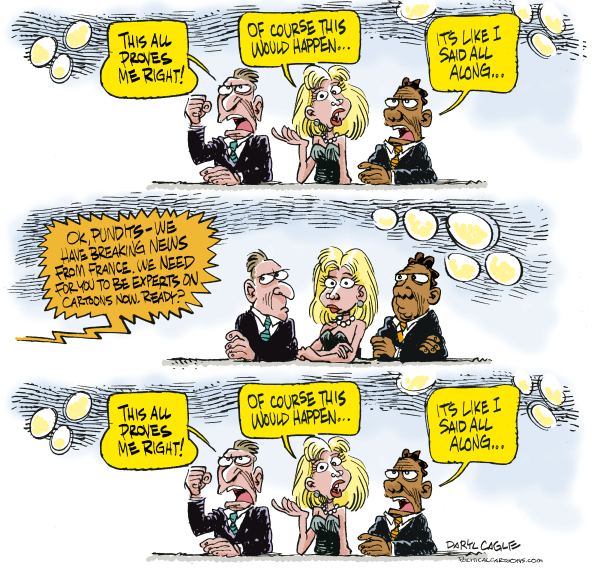
Charlie Hebdo TV Pundits

158510 600 Charlie Hebdo TV Pundits cartoons

Categories
Blog

The Media and Red Lines

158487 600 The Media and Red Lines cartoons

Categories
Blog

With Our Love to Charlie Hebdo

158375 600 With Our Love to Charlie Hebdo cartoons