Categories
Blog Syndicate

France Weeps

We’ve been receiving a torrent of cartoons from around the world about last Friday’s terror attacks in Paris. I’ve been disappointed by most of the cartoons so far, many of which contain graphic pools of blood, depictions of monsters and broken Eiffel Towers. I think the first few days after an event like this are a time to express sympathy, so I went with a weeping Marianne, the French symbol from the Eugene Delacroix painting La Liberté Guidant le People (Liberty Leading the People). 

Marianne2
Delacroix’s Marianne.

I struggled to think of what I wanted to draw, so I wouldn’t be drawing blood, candles, monsters or Eiffel Towers like the rest of the crowd. I like Marianne as a symbol for France and I like that the French embrace her as their own symbol. It was interesting to see so many of the cartoonists drawing the Statue of Liberty this weekend, the statue was a gift from France but she is a symbol of America.

Marianne has some problems: first, she may not be recognizable enough when she is seen out of the context of the Delacroix painting: second, her face exists only as a profile facing left, which can be a little limiting; third, she has one bare breast (or arguably, two bare breasts) and American editors are reluctant to print bare breasts – even though her bare breast is necessary to define who Marianne is in the cartoon. I suppose it is fitting that I had to struggle with this one.

Below is my rough sketch.

FranceLibertySketch700

I started out thinking of more cliches, like the candle and the flag at half staff – both bad ideas. I also ruminated about how to draw the drapery in her dress, which seems to be a heavy fabric rather than a normal fabric, along with her emerging toes. Here she is in black and white. (Yes, the flag pole covers up her nipple – I debated about that too.)

Then I colored her in – and I was disappointed with the result.

france-weeps-cagle-COLOR

Editors and readers always like cartoons better when they are in color, even in cases like this, where the color only cheapens the cartoon. One of my readers on Facebook, Rod Underhill, made the excellent suggestion that I limit the color to the flag; that was a great suggestion – and voila, a much better cartoon (shown at the top of the page)! I deleted the previous color version and sent a correction out to the newspaper clients.

Here’s another Marianne cartoon, a double breasted version. This one was popular in France where they find President Francois Hollande rather annoying.

This interesting Marianne comes from my French cartoonist buddy, Pierre Ballouhey, who includes characters surrounding the recent Paris attacks.

2015-11ballouhey-700

Marianne is much easier to deal with in a goofy drawing. Here’s a nice Marianne by Angel Boligan, drawn after the Charlie Hebdo attacks.

This bloody Marianne is from my buddy, Martin “Shooty” Sutovec from Slovakia. With no side-boob, and no flowing ties on her sleeveless, fringeless dress, her new style beret and blonde hair in a different doo – I almost missed her, but Shooty got me to take another look.

shooty-marianne

Jordanian cartoonist Osama Hajjaj drew a weeping Marianne with an Eiffel Tower in a pool of blood (perhaps he could have thrown in a couple of candles, terror monsters and the Statue of Liberty to make it complete). Osama obscured Marianne’s profile and bare breast issues, and he lost her beret. hmm. OK.

This Marianne is from Taylor Jones, after the Charlie Hebdo attacks.

Here’s a Charlie Hebdo aftermath Marianne from RJ Matson – looks like this one was a quicky to draw in Photoshop.

Visit our big collection of cartoons drawn in response to the Paris attacks.


Categories
Blog Syndicate

Andy Singer’s Panel Cartoons in the Editorial Cartoon Spot

Editorial page editors typically reject anything new and different from editorial cartoonists. Unusual styles and formats are just not what editors want to see. Editors like cartoons that look like what they think editorial cartoons should look like – which leads to lots of cartoons that look much the same.

I’ve been a big fan of Andy Singer’s self-syndicated, altie “No Exit” panel for years, and I’ve been encouraging Andy to try his hand at more traditional editorial cartooning. Andy’s panel has content that is socially conscious, like an editorial cartoon, but it is not the right shape, and it is wordy, and it doesn’t have caricatures of politicians and the panel format with a title is simply not something editorial page editors will consider putting in their daily editorial cartoon hole.
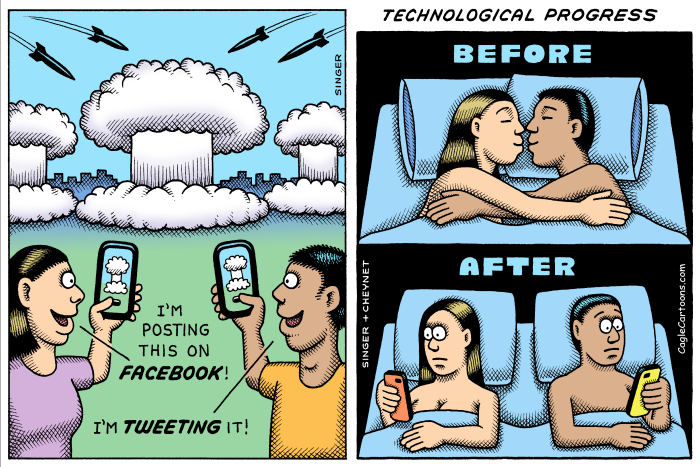
What to do? Andy wanted to be on the editorial pages but was committed to continuing the “No Exit” panel. Then he gave me a new pitch, saying, “Daryl, you know, when I put two of my panels next to each other it becomes the shape of an editorial cartoon, and if I do two panels that are on the same topic, and color them, it looks like one big editorial cartoon.” The idea looked interesting to me. The result is rather stylistically different than what editors are used to but Andy’s new editorial cartoon format looks like wordy, multi panel editorial cartoons, and editors seem to be accepting them. The connection between the two panels might be a stretch, but no one seems to notice. So far, so good.

A number of comic strip cartoonists, Like Dan Piraro and Wiley Miller, have been doing their cartoons in both strip and panel format for years. Andy’s work has some format advantages over most magazine gag cartoonists’ work; Andy’s panels are topically editorial cartoons to start with, and he doesn’t have a classic gag cartoon style with a caption at the bottom, which would be more difficult to reformat. Still, it may be that some other socially conscious panel or gag cartoonists could develop a new market by finding a procedure to reformat their ongoing work as editorial cartoons. Andy Singer is the trailblazer.

One of Andy’s new, combined format cartoons for the editorial pages. With the same characters and consistent color and format, it looks right as a single editorial cartoon and is proving popular so far.

Here are a couple more new editorial cartoons from Andy. Follow Andy’s work on Cagle.com here.

Categories
Blog Syndicate

Dr. Ben Carson is NOT a Liar!

I think Dr. Ben Carson is NOT a liar. Now, given that, I need to decide if that is a good thing.

carson-on-caglePeople always say, “Daryl, with this presidential election you must be having so much fun! And you must be soon busy!” Actually, newspapers don’t use any more editorial cartoon when times are fun, so it never gets busier. And having the campaign dominate the news for a year doesn’t make a cartoonist’s life more fun. A little variety adds spice.
But, Ben Carson is fun. We have a wonderful and growing collection of Ben Carson cartoons on Cagle.com Come take a look! My talented buddy Taylor Jones drew that Carson in our promo.

Here are a couple of my recent favorites, this first one is by my buddy, Jeff Koterba of the Omaha World-Herald:

This one is by the brilliant Kevin Siers of the Charlotte Observer:

This strange one from Randall Enos made me laugh out loud – it is a linoleum block print that Randy carves with a knife, inks and prints on paper, then scans, showing Jesus carrying a sleeping Carson at the head of the presidential race – I think that says it all.

Categories
Blog Syndicate

Ben Carson and the Media

Dr. Ben Carson seems to have a thin skin when it comes to the media.

Editorial cartoonists have a wonderful advantage versus other journalists; we can put any stupid words we want into the mouths of any public figure. Regular journalists have a slightly higher bar – they have to act like jerks to try to coax a testy quote out of a public figure. Carson’s calm demeanor likely encourages the press to prod him even harder.

Carson say plenty of stupid things without prodding. He holds some of the most knuckle-dragging views on the neanderthal right. What worries me most is the crazy religious views that color right-wing views of reality, like Carson’s rejection of the theory of evolution. His belief that the pyramids were built to store grain at the direction of Joseph (the many colored coat Joseph) is funky a one. Where this becomes dangerous is when right-wing candidates believe that we’re at the “End of Days”, and the turmoil in the Middle East shows that the apocalypse and the return of Jesus Christ is imminent – that can lead to some ugly decision making.

If not for the nutty religious stuff I might be a Republican myself.

Well, maybe not.

Here’s a very close-up blow-up of Ben Carson’s tiny face. From this you can see that I really do draw in pencil and crank up the contrast to make it look like ink. I use yellow Dixon Ticonderoga pencils, with little pink erasers on the end (I always use up the pink erasers). Pencils are forgiving to indecisive cartoonists, like me.

CarsonDetail

Categories
Blog Syndicate

The Inside Story on Obama’s Meeting with Netanyahu Today

It is no secret that Obama and Netanyahu don’t like each other, and it is amusing to watch them act like they are buddies – therefore today’s cartoon …

And here’s the rough sketch …

sketch700

I don’t draw Netanyahu very often, so I had to do Google Images to see what he looks like, and I erased his face two or three times before I thought I got close enough. Notice that the final Netanyahu face is much better than the sketch – that always happens with me. I stare at the Google Images Netanyahu faces as I’m tracing the final line art and it gets closer to the right caricature with another step. I went in a different direction with his big nose than I see other cartoonists do – I’m still not sure about that.

Notice that when I’m free-handing something like this, I don’t get it right. Obama is too high and Netanyahu too low for their eyes to meet, so I noted that Netanyahu needed to stretch up to make eye contact and I made the correction as I was tracing it. I never just trace, I’m always redrawing, which can be frustrating, because my natural inclination would be to continue redrawing forever. Rough sketch Obama was looking pretty lousy here too – that’s why artists don’t like to show their rough sketches – rough sketches are lousy!

There you have it, the inside story on the meeting of Obama and Netanyahu today!


Categories
Blog

Jeb Can Fix It!

I’ve been seeing a bunch of very complicated cartoons about Jeb Bush’s attempt at a Jeb!2.0 campaign – with Jeb fixing cars that are hopelessly broken, Jeb as a plumber failing as the plumbing floods – and the like.

For my Jeb cartoon I started with the idea that I wanted to do something simpler, and I really wanted to do a plumber’s butt crack. There’s a famous story about cartoonist Steve Kelley who was fired from his job at the San Diego Union-Tribune for drawing about this much of a butt-crack. I think Steve’s experience motivates all of the cartoonists to draw butt-cracks.

jeb-can-fix-it


Categories
Blog Syndicate

Journalism and Cartooning Professions Race to the Bottom

Take a look at my editorial cartoonist/journalist daughter Susie’s project at Stanford about the future of journalism.

I think that as journalists (and cartoonists) work as freelancers for lower and lower fees, the respect and quality of the working relationships we have with our clients also declines – as Susie writes, a race to the bottom for our professions and ultimately for the quality of our work, and the quality of the media.

From Susie:

What is your journalism challenge? What problem are you working to solve?

Like every industry, journalism has a labor problem. As media companies have grappled with digital disruption, they’ve responded by cutting jobs and salaries, but not necessarily cutting “content.” That work has instead been assigned to a growing legion of freelancers and contractors — independent work that has always existed, but that has taken on a more vital role to the survival of many cash-strapped media institutions, both new and legacy.

With so many opportunities yet so few resources, freelancers are by nature pitted against one another in a race to the bottom. This doesn’t work particularly well for anyone: for editors, who need a consistent and high-quality pool of writing, staffers, who risk being undercut at their jobs, or readers, who want to support living wages for workers.

This is not to say that freelance journalism can’t work! But it can’t work like this.

How would solving this problem help journalism?

While the Internet has done much to lower the entry barrier to media work — which is great — it’s also lowered the standards of that work — which is not great. Many freelancers report that they receive little to no editing or fact-checking. In a race to pump out more “content,” this has the potential to result in huge errors — and to promote a different kinds of journalism altogether.

In an industry that prides itself on transparency and ethics, there are no standards as to how these workers or their work should be treated. Living wages and ethical work standards are in everyone’s best interest.

Who is tackling a similar problem and how is your approach different?

There are many efforts aimed at supporting independent workers across industries. Projects specific to journalism — such as ContentlyBeacon and WordRates — have largely centered on gig-matching, which has its own strengths, but does not address many of the issues facing freelancers.

A single tool or platform can’t fix such a complex problem. I believe organizing of freelancers is best done in small cooperative affinity guilds, where problems such as lack of administrative and legal assistance, libel insurance, press passes, and tools, and service fees can be better solved. The first step toward this vision is promoting more transparency and cooperation in a field that’s traditionally very individualistic and competitive. I plan to negotiate with writers, editors, and publishers to find common ground on these issues. I’m also talking to creators of digital payment and publishing tools about how those might better work for independent journalists.

What are the first questions you plan to pursue?

  • Is this employment shift in media to more contracts and fewer jobs actually indicative of and part of a larger shift in work across industries? If so, what does that mean for freelance journalists, and how might we work in solidarity with freelancers in other industries?
  • Who are the freelance journalists working in the U.S. today? Where are they, how are they working, and for how much?
  • In what ways does contract journalism work and not work for editors and publishers? How do they perceive freelancers? Who do they think we are, and how do they think we work?

What are the first steps you plan to take in working on your challenge?

I’m interviewing freelancers, editors and publishers about these labor issues and will be publishing some of that work on Patreon for my subscribers. Those funds will support some of my more ambitious plans for this project. The first batch will go toward making Who Pays Writers, a project of Manjula Martin and Scratch Magazine, into a searchable database.

Who Pays is an unmatched resource for freelancers — users submit not just rates, but also information about how long payment took, the terms of their contracts, and any other issues that arose. Overall, this data shows that there are no standard terms or rates for writers, even at the same publication.

We also have some more ambitious plans for using this data to better promote wage transparency.

Susie Cagle

Categories
Blog Syndicate

St Just and Georges Wolinski

I’ve been attending the editorial cartoonists convention in St. Just le Martel, France in recent years, and it is always great fun – but this year it had a somber tone, along with the biggest attendance ever, in the wake of the Charlie Hebdo murders.

mewMoineHebdoPortraits
That’s me in front of portraits of the five slain cartoonists drawn by Moine, the brilliant, French architect turned cartoonist who had a huge exhibition of cartoonist caricatures in the main gallery. Thats Honore, Cabu, Wolinski, Tignous and Charb in the portraits; I’m obscuring Wolinski. Moine has drawn portraits of most of the regulars at St Just, and had the drawings published in a book that is treated much like a high school yearbook at the convention, with everyone signing their own pages in other cartoonists’ books.
Georges-Wolinski300x300
Georges Wolinski


George Wolinski was a regular at St Just every previous year I attended. He was a convention friend who enjoyed encouraging my wife to drink much more and he stood out as a star of the convention, highly respected by his French colleagues.

The museum built a lovely memorial to Wolinski by recreating his Paris studio, pictured below. The furnishings were moved to St Just and every detail was replicated, including the positions of the books and the art materials on his drawing tables.

WolinskiStudio1


WolinskiStudio2
Visitors look through two large windows into either side of the studio enclosure. The windows inside the studio recreate Wolinski’s view of Boulevard Saint Germain in Paris’ trendy Rive Gauche. Wolinski’s wife came to St Just to make sure every detail in the studio was correct.

WolinskiBook2WolinskiStJustPosterSmall
Wolinski was a prolific cartoonist and his work stretched well beyond Charlie Hebdo. He was known for his sexy cartoons. The book cover at the left is typical of Wolinski’s work. On the right is a poster that Wolinski did for the St Just festival. The poster for the festival is drawn each year my the winner of the “Humor Vache” award, a cow.

This year’s cow winner is “Coco,” another Charlie Hebdo and St Just regular; this was the second cow for Coco, who was a popular choice after her terrible ordeal during the attack, and her excellent work coming back after the horror. I’ll do another post on Coco.

The appreciation for the editorial cartooning profession that is on display at St Just is wonderful to see. Each convention is like a cartooning family reunion, and the loss of five members of the family was an awful blow to the community.


perfectmassage
This is typical Wolinski. I took this photo of one of his pieces titled “The Perfect Chinese Massage” from his exhibit at St Just. A lot of his work is wordy with lots of French that I don’t understand – but this one I can understand.


Categories
Blog Syndicate

Reince Priebus

I think Republican Party Chairman Reince Priebus is funny. His name is funny. His face is funny. Everything about the guy is funny – but he’s tough to draw in a cartoon because most readers don’t know him. It is only wonks like me who watch cable tv news talking heads all day who get to know the guy. But what the hell, I drew him anyway.

reince-priebus-debates-cagle

I was also looking for an excuse to use this brick wall. Brick walls are funny too. And that last Republican debate on CNBC, that was funny.

I’d love to hear the negotiations that are going on about the next GOP presidential debate. Their first list of demands was funny.

Here is the rough sketch (you guys tell me you like to see this stuff). You can see that I was undecided about where to put Reince’s left arm. Maybe he’s better with four arms.

PriebusSketch

Categories
Blog Syndicate

Boots on the Ground in Syria

President Obama took another military step in Syria, authorizing American special forces to conduct combat operations, despite his promise to have “no boots on the ground” in Syria. I suppose my now we shouldn’t take these promises too seriously.

There have been a whole lot of quagmire cartoons about Syria. I noticed this similar, recent one by my buddy Steve Sack after I sent mine out – Steve’s is better.

Here’s an Afghanistan quagmire from Chinese cartoonist, Loujie.

Here’s a nice quagmire from Australian cartoonist, Paul Zanetti.

Here’s an Iraq quagmire from Dave Granlund …

… and an Obamacare quagmire from my buddy, conservative cartoonist Eric Allie …

Quagmires are a cartoon standard.

Here’s my quagmire cartoon in USA Today today. It has been a long time since I worked for MSNBC.com, but it is a never ending quest to get people to change my attribution. (Does it help that they call it “Toon Talk”?)

DarylinUSAtodayToday